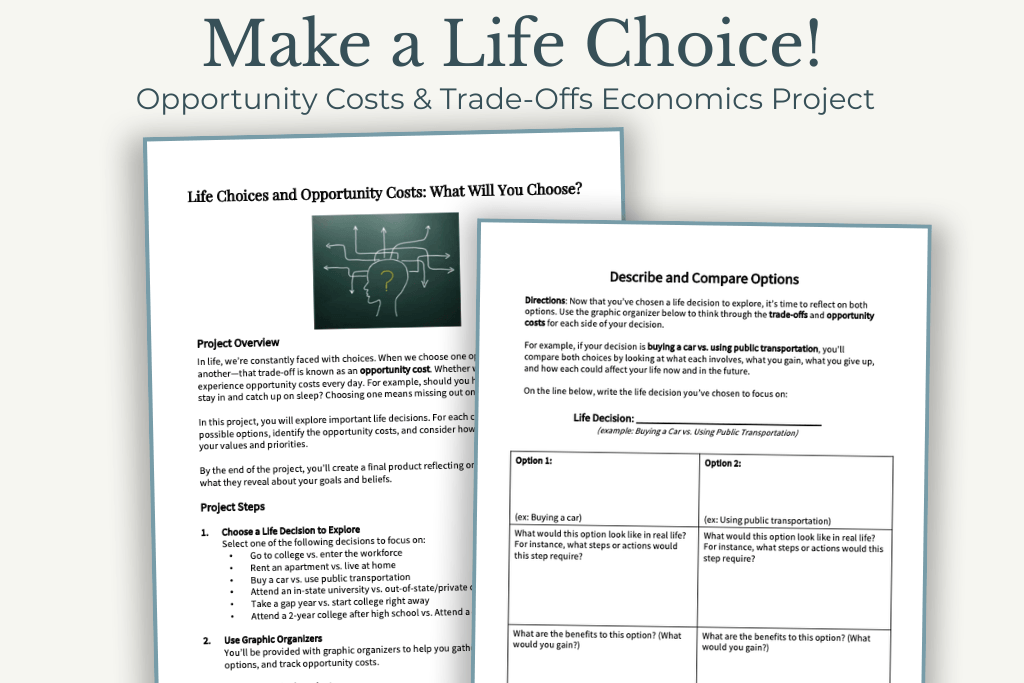
Why Opportunity Cost Can Be Difficult for High School Students
It’s easy to teach students the definitions of economic terms, but the real issue isn’t whether students can memorize the definition. It’s whether or not they can apply it to their own lives.
When I taught high school economics, I often wondered how I could make it more fun and relevant for students. All I remembered from my own high school economics classes were graphs and vocabulary terms. I didn’t really know what any of it meant, but I copied it all down into my economics notebook anyway.
When I became a high school economics teacher, I’ll admit that during my first few years, I taught economics the same way I had learned it because I was just trying to survive. It was a disaster for everyone in that classroom. Students memorized terms for tests, but they didn’t actually understand how economics connected to their everyday lives.
After those first few years, I wanted to do something different to make economics feel more practical instead of abstract. I started creating economics projects where students were “doing” economics instead of just memorizing terms and taking tests. Once students started applying economic concepts to real-life situations, I noticed they became much more engaged in the class.
A Real-World Opportunity Cost Project for High School Economics
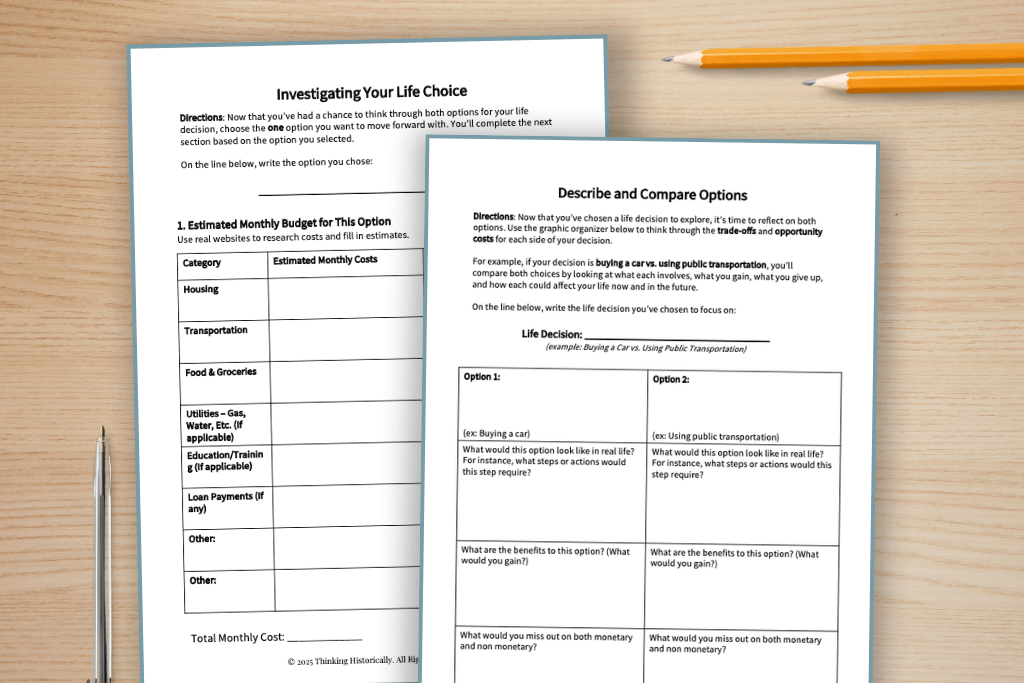
One of the projects I created is a Life Decisions and Opportunity Costs Project. In this high school economics activity, students compare two realistic options. Some examples include: going to college vs. entering the workforce, renting an apartment vs. buying a home, or taking a gap year vs. starting college right away.
The goal of these options is to give students something they can actually relate to and something they would genuinely be interested in researching. Instead of looking at random economics examples from a textbook, students are thinking through decisions they may actually face in a few years.
After students choose two options, they gather information to compare them and track the opportunity costs involved in each decision. As students compare their choices, they analyze both the short-term and long-term consequences to help them make a final decision.
Some students realize how expensive living on their own can actually be, while others begin thinking more deeply about student loans, career opportunities, or the benefits of living at home for a few years. The conversations that come out of this project are often some of the best discussions we have all year in economics class because students have strong opinions about the choices they are researching.
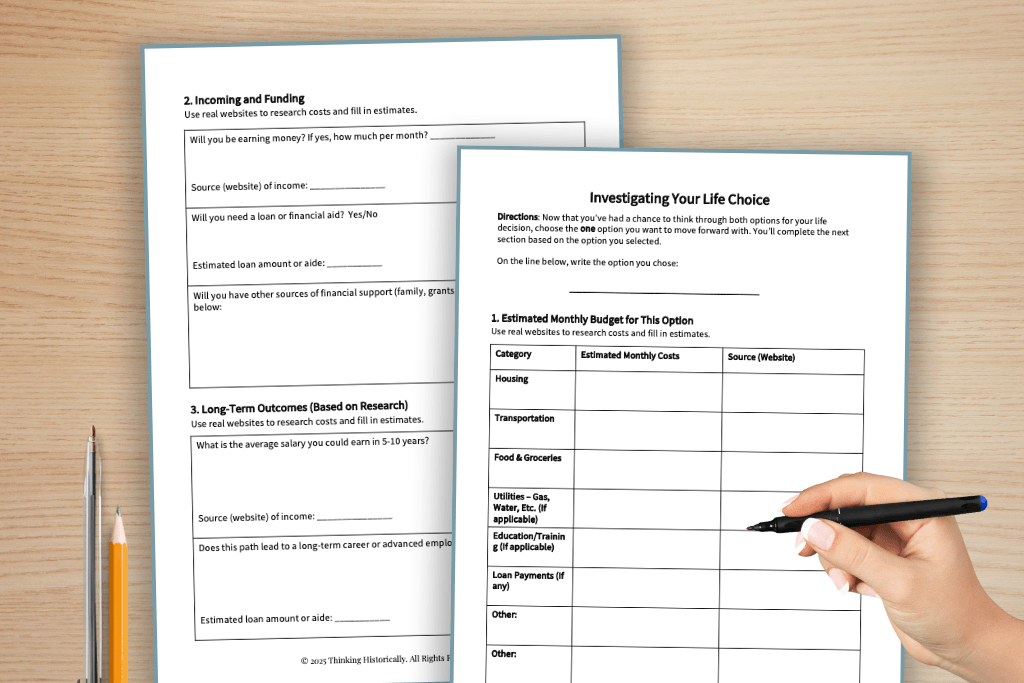
Once they make their choice, students then work through how their life could be affected by that decision. They do this by creating a monthly budget based on the path they chose. This part of the project helps students see that economic decision-making involves real trade-offs and sacrifices.
What Students Learn from This Economics Decision-Making Activity
This project goes beyond memorizing definitions because students are actively weighing their two options and thinking through the consequences of each choice. Instead of simply identifying an opportunity cost on a worksheet, students are applying economic thinking to realistic life decisions.
In this project, I provide students with graphic organizers that help guide their thinking throughout the decision-making process. These organizers include questions such as:
“What might your life look like in 1–2 years if you choose this option? What might it look like in 5–10 years?”
As students work through these questions, they begin to realize that there usually isn’t a “perfect” choice. Every decision comes with trade-offs, sacrifices, and benefits. Students also begin thinking more critically about how the decisions they make today can affect their future finances, careers, and lifestyles.
By the end of the project, students present their work and identify the trade-offs and opportunity costs involved in their decision. They also use evidence from their research and budgeting activity to justify their final choice.
Why Students Are More Engaged During This Economics Project
I’ve found that when students complete projects like this, economics becomes much more meaningful to them. Students are usually more engaged and much more willing to participate because the project connects directly to their own lives and future decisions.
I also notice that classroom discussions become much stronger during this project compared to traditional economics worksheets or lectures. Students genuinely want to debate their choices and explain their reasoning to each other. Even students who are normally quieter during class discussions tend to participate more because they have personal opinions about the topics.
For many students, this is one of the first times economics feels connected to real life instead of just graphs and vocabulary words.
An Easy-to-Implement Economics Project for High School Students
This economics project is designed to be low prep and easy to implement in a high school economics or personal finance classroom.
This project includes:
- Suggested Teaching & Pacing Guide
- Ready-to-Use Student Materials
- Student Reflection Questions
- Rubrics for Easy Grading
- Google Docs Version for Digital Use
If you’re looking for a ready-to-use economics project that helps students apply opportunity cost and decision-making to real-life situations, you can check out the full Life Decisions & Opportunity Costs Project here.
Making Economics More Meaningful for Students
At the end of the day, I think students learn economics best when they can actually see how it connects to their own lives. Projects like this help students move beyond memorizing vocabulary words and start thinking more critically about the choices and trade-offs they may face in the future. It also helps economics feel more practical and meaningful for students who may normally struggle to connect with the subject.
If you’re looking for a real-world economics activity that encourages critical thinking and student engagement, this project has been one of my favorite ways to teach opportunity cost and decision-making in the classroom.